
- The Income-tax Act, 2025, a landmark reform in India’s direct tax framework, represents a comprehensive effort to simplify and modernise the country’s income-tax law, replacing the six-decade-old Income-tax Act, 1961.
- It marks a shift towards greater clarity and ease of compliance through simple language, a streamlined structure and a reader-friendly presentation, without altering the underlying tax policy.
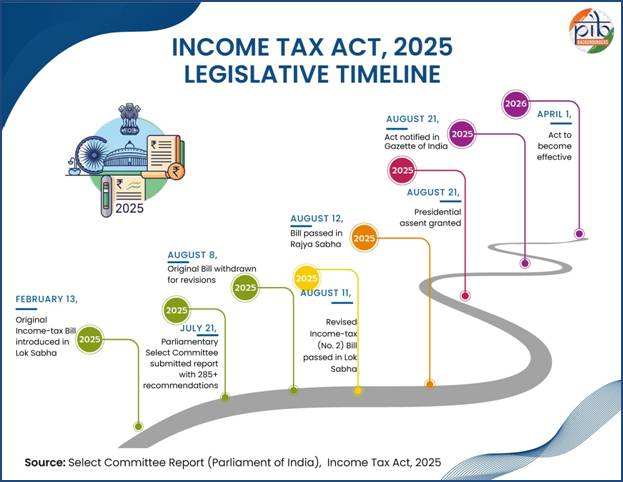
- To modernize and simplify India’s outdated tax laws, the government announced a comprehensive review of the Income-tax Act, 1961. This led to the introduction of the Income-tax Bill, 2025, which was referred to a Select Committee of Parliament for detailed examination.
- After receiving extensive recommendations and suggestions from stakeholders, the government decided to withdraw the original Bill and introduce a revised version – The Income-Tax (No. 2) Bill, 2025.
- This updated Bill incorporated most of the committee’s inputs along with improvements in legal clarity and drafting.
- It was passed by both Houses of Parliament in the monsoon session and now forms the foundation of India’s new tax framework.
- The Bill was passed by the Parliament on 12th August, 2025, and received the assent of the Hon’ble President of India on 21st August, 2025, thereby becoming the Income-tax Act, 2025. ( Gazette Notification – Income-tax Act, 2025)
- The Income-tax Rules, 2026 were notified by the Central Board of Direct Taxes on 20th March, 2026 to operationalise the provisions of the new Act. (Gazette Notification – Income-tax Rules, 2026).
- The corresponding new Forms have also been notified. The Forms have been simplified, standardized and process re-engineered to make compliance simpler.
- With its coming into force from 1st April, 2026, the Income-tax Act, 2025 marks a new chapter in India’s tax administration and an important step towards Viksit Bharat.
Simplified Framework of Income Tax Act, 2025
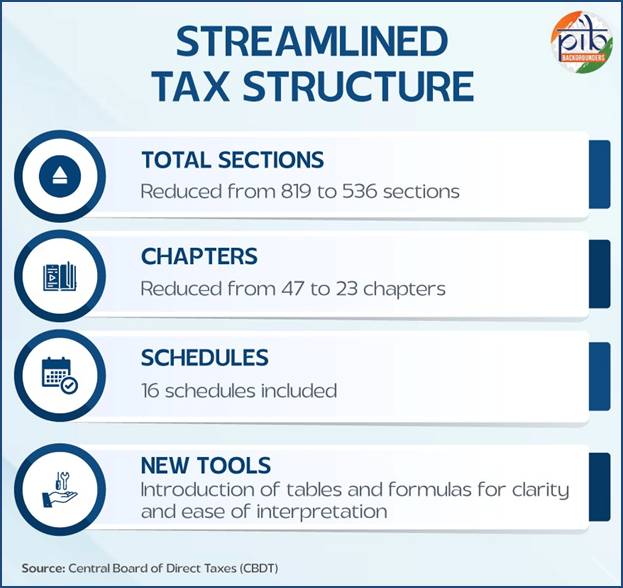
- Simpler language and Framework: Act has been condensed from 819 to 536 Sections, and 390 to 190 Forms.
- Provisions of Minimum Alternate Tax (MAT) and Alternate Minimum Tax (AMT) have been separated into two sub-sections.
- MAT bring into the tax net “zero tax companies” which in spite of having earned substantial book profits and having paid handsome dividends, do not pay any tax due to various tax concessions and incentives provided under the Income-tax Law.
- AMT has similar provisions as MAT which is applicable to non-corporate tax payers.
- The provisions of MAT are applicable to a corporate taxpayer only.
Key Features of Income Tax Act, 2025
The Income Tax Act, 2025 introduces a streamlined and modernized framework for direct taxation in India. It focuses on clarity, simplification, and improved compliance through structural and procedural reforms. The Act is designed to enhance transparency, reduce litigation, and align with technological developments.
| Introduction of ‘Tax Year’ | ||
|
||
| Power to Frame Schemes | ||
The Act authorizes the Central Government to design new schemes aimed at improving efficiency, transparency, and accountability in tax administration (S. 532). This can be done by:
|
||
| Simplified Compliance | ||
|
||
| Digital-First Enforcement | ||
|
||
| Dispute Resolution | ||
|
From Complexity to Clarity: Rationale Behind the New Income Tax Act
The Income-tax Act, 1961 was introduced to replace the earlier 1922 legislation, based on recommendations from the Law Commission (1958) and the Direct Tax Administration Enquiry Committee.
Here are the factors contributing to the complexity of India’s Income-tax Act, 1961:
- Extensive Amendments: The Act has been amended nearly 65 times with more than 4000 amendments over six decades through annual Finance Acts and 19 separate Taxation Laws Amendment Bills. While these changes were intended to keep the law relevant, they significantly increased its length and complexity.
- Numerous Exemptions and Deductions: Over the years, the Act was repeatedly amended to include various exemptions and deductions to support socio-economic goals, such as encouraging savings, boosting exports, promoting balanced growth, and advancing social equity. These provisions included benefits for export income, investments in specific sectors or regions, and spending on rural development.
- Reduced Tax Base and Increased Litigation: The numerous exemptions and incentives significantly reduced the tax base, which in turn contributed to increased litigation, higher administrative costs, and greater compliance burdens.
- Traditional Legal Language: The Act was written in traditional legal language, characterized by long sentences, numerous provisos, and extensive explanations, making it difficult for the average taxpayer to understand.
- Fragmented Structure and Outdated Provisions: The accumulation of amendments and additions led to a fragmented structure. This complexity was further compounded by the presence of outdated provisions that were no longer in use.
Reform Process for the New Tax Legislation
- In July 2024, the Finance Minister announced the Government’s intent to overhaul the Income-tax Act, 1961, aiming to simplify its language, reduce disputes, and eliminate outdated provisions. To lead this effort, an internal Departmental Committee was constituted by Central Board of Direct Taxes (CBDT) for comprehensive review of the existing Act.
- The Committee actively engaged with stakeholders – industry bodies, professional associations, and field officers of tax department – through consultations and brainstorming sessions. It also drew insights from international best practices, including tax reforms in the UK and Australia. The focus extended beyond language to include structural streamlining of the law itself.
To reframe Income Tax law framework, the simplification exercise followed three guiding principles:
- Textual and structural simplification for improved clarity and coherence.
- No major tax policy changes to ensure continuity and certainty.
- No modifications of tax rates, preserving predictability for taxpayers.
The drafting process of the Income Tax Act, 2025 was anchored in a threefold framework, each component playing a critical role in shaping the legislation’s structure, intent, and implementation strategy:
- Eliminating intricate language to enhance readability.
- Removing redundant and repetitive provisions for better navigation.
- Reorganizing provisions logically to facilitate ease of reference.
The New Tax Vision: Goals and Direction
The Income Tax Act, 2025 has been introduced to modernize India’s direct tax framework, focusing to simplify and streamline tax legislation, making it more accessible, transparent, and less prone to litigation. By adopting plain language and restructuring provisions logically, the Act aims to reduce taxpayer confusion and improve voluntary compliance. It also seeks to minimize disputes through clearer definitions and harmonized assessment timelines. The reform reflects India’s commitment to align with global best practices, improving ease of doing business, and fostering a trust-based tax environment. In essence, the Act is designed not to overhaul tax rates, but to overhaul the tax experience – making it more predictable, efficient, and digitally enabled.
Core Objectives:
- Simplification: Replace archaic language and redundant provisions with clear, concise, and modern legal text.
- Digital Integration: Enable faceless assessments and digital compliance to reduce human interface and corruption.
- Taxpayer-Centric Approach: Improve ease of filing, reduce litigation, and enhance transparency.
- Global Alignment: Reflect contemporary economic realities, including taxation of digital assets and global income.
Conclusion
The Income Tax Act, 2025 represents a transformative step toward building a more transparent, efficient, and taxpayer-friendly direct tax system in India. By simplifying legal structures, embracing digital processes, and aligning with global standards, the Act lays the foundation for a modern fiscal framework. Guided by Prime Minister Narendra Modi’s vision of a developed and inclusive India, this reform reflects the government’s commitment to ease of compliance, economic growth, and institutional accountability