
National Voters’ Day 2026
- National Voters’ Day is observed on January 25th across India to honour voters, encourage youth participation, and strengthen democratic values, and promote universal adult suffrage.
- The theme for National Voters’ Day 2026 is “My India, My Vote” with a tagline of Citizen at the Heart of Indian Democracy.
- The ECI has introduced multiple reforms to strengthen India’s electoral integrity. SVEEP has boosted voter education, and ECINET has supported global technology sharing.
- cVIGIL has enabled quick reporting of violations. 100% webcasting at polling stations has enhanced transparency. EPIC delivery has been fast-tracked to 15 days.
Introduction
- India observes National Voters’ Day on January 25 each year. It celebrates democracy and empowers every citizen to take part in the electoral process.
- The day marks the foundation of the Election Commission of India (ECI), which was established on January 25, 1950, under Article 324 of the Indian Constitution.
- The ECI is a pivotal constitutional authority responsible for the control, supervision, and conduct of elections in the world’s largest democracy.
- It has conducted 18 general elections and over 400 State Legislative Assembly elections till date.
- The Commission also oversees elections to the Rajya Sabha, State Legislative Councils (wherever they exist), the Union Territories of Puducherry and the National Capital Territory of Delhi, as well as the esteemed offices of the President and Vice President of India.
- It is a multi-member body comprising the Chief Election Commissioner and two other Election Commissioners.
Significance of the National Voters Day (NVD):
- Voters’ participation in the democratic and electoral processes is integral to the successful running of any democracy. It is the very basis of wholesome democratic elections.
- In India, ECI ensures that every eligible Indian is on the Electoral Roll. It must also work to get everyone on the roll to voluntarily vote.
- In order to reach out to the masses, the Election Commission of India (ECI) initiated the practice of celebrating National Voters’ Day (NVD) on its Foundation Day, i.e., 25 January, in 2011.
- NVD helps fulfil this constitutional responsibility. It creates awareness about voter registration and participation. The day encourages eligible citizens to enrol themselves and exercise their democratic right to vote.
- The day is dedicated to all voters of the nation. Enrolment of new voters is a key focus of this celebration. Across India, new voters are honoured on this day.
- NVD is being celebrated across the country at around 11 lakh polling booths, at district level by District Election Officers (DEO) and at State level by Chiel Electoral Officers (CEO). The Booth Level Officers (BLOs) organize event at each polling station area and felicitate newly registered voters.
Transformative Electoral Reforms over the Years
India’s electoral system has undergone continuous transformation through a series of institutional, technological, and voter-centric reforms. These are aimed at strengthening democratic participation and electoral integrity.
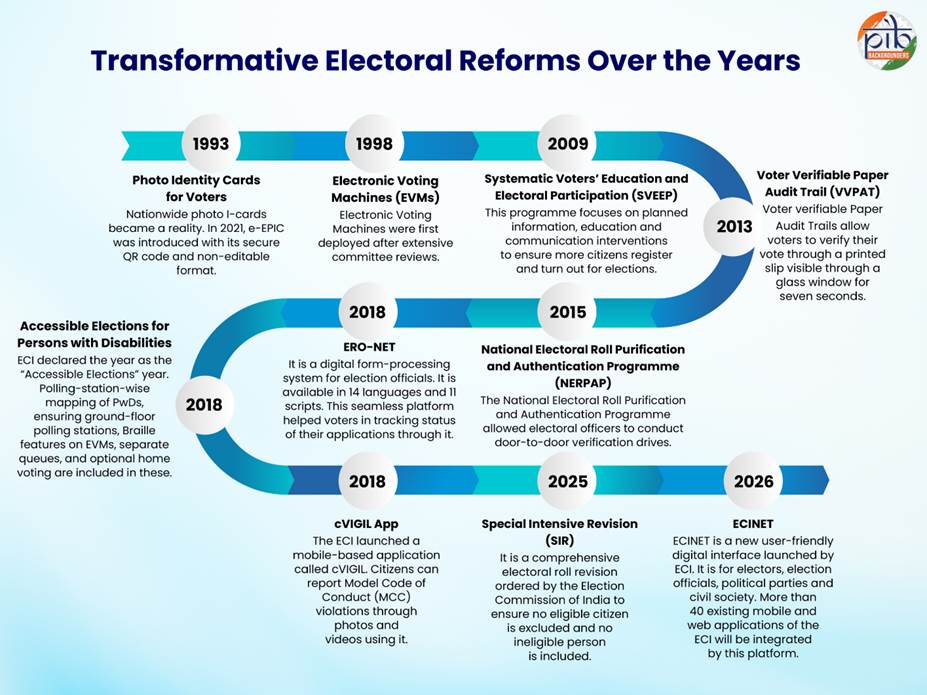
Several other initiatives have also further strengthened the efficiency, inclusiveness, and transparency of the electoral process:
Polling Station Management
- Mobile Deposit Facility at Polling Stations: Mobile phone deposit counters placed outside polling stations to ensure compliance and smooth polling.
- Polling Station Limit of 1,200 Voters: Maximum voters per polling station capped at 1,200 to reduce crowding and ensure shorter queues. Additional booths placed in high-rise residential complexes and societies.
- 100% Webcasting at Polling Stations: Webcasting ensured at all polling stations to monitor critical poll-day activities. It also assured activities to take place without any violation.
Voter Services & Information
- Clearer Voter Information Slip (VIS): VIS redesigned with clearly visible serial and part numbers for easier voter verification.
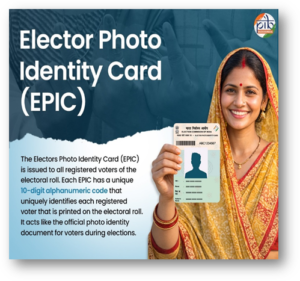
- Fast Delivery of EPIC: New SOP ensures EPIC delivery within 15 days of an update in Electoral Rolls. It is also accompanied by SMS updates at every stage.
Electoral Roll Management
- Special Intensive Revision in Bihar: Focused revision conducted to remove ineligible names and include all eligible voters.
- Obtaining Data of Death Registration: Electronic sharing of death registration data enabled for electoral roll updates.
- Special Summary Revision (SSR) before Bye-Elections: Special Summary Revision conducted before bye-elections for the first time in nearly 20 years.
Technology & Digital Systems
- Digitisation & Resource Optimisation at ECI HQ: e-Office, biometric attendance, and relocation to IIIDEM (India International Institute of Democracy and Election Management) for efficiency.
- Digital Index Cards & Reports: Returning Officers enabled to release index cards digitally within 72 hours of result declaration.
Training & Capacity Building
- Training of Booth Level Agents (BLAs): BLAs trained on electoral roll preparation and appeal provisions under RP Act, 1950.
- Training of Booth Level Officers (BLOs) at India International Institute of Democracy and Election Management (IIIDEM): Over 7,000 BLOs and supervisors from across India including Bihar trained at IIIDEM to strengthen field-level capacity.
- Training of Police Officers: Special training sessions conducted for police to ensure election-time law and order.
- Training for Nodal Communication Officers: Media and communication officers from all States/UTs trained for effective outreach.
Election Staff & Officials
- Photo ID Cards for Booth Level Officers (BLOs): Standard photo identity cards issued to BLOs to improve transparency and public confidence.
Counting Process
- Streamlining Counting of Postal Ballots: Postal ballots counted before the penultimate round of EVM/VVPAT counting.
Stakeholder Engagement
- All-party Meetings Nationwide: Regular meetings held by Chief Electoral Officers (CEO), District Election Officers (DEO), and Electoral Registration Officers (ERO) to engage political parties. A total of 4,719 all-party meetings were conducted. It included 40 meetings by CEOs, 800 by District Election Officers (DEOs), and 3879 by Electoral Registration Offices (EROs).
- ECI Meetings with Party Leadership: Continuous dialogue maintained with national and state party leadership. 25 such meetings have been held so far.
Political Party Regulation
- Delisting of Registered Unrecognised Political Parties (RUPP): Delisting of 808 Registered Unrecognised Political Parties in two rounds. These parties failed to meet the essential conditions for registration.
Legal & Institutional Framework
- Re-orient ECI Legal Framework: National conference with Legal Counsels & CEOs to strengthen and re-orient ECI’s legal framework.
International Cooperation
Bilateral engagements held with Election Management Bodies of other countries. A landmark event in this regard was the India International Conference on Democracy and Election Management (IICDEM) 2026, held from January 21-23, 2026, in New Delhi. The conference brought together representatives from over 40 Election Management Bodies (EMBs) across the globe. It concluded with the unanimous adoption of the Delhi Declaration 2026 on January 23, 2026.
The Declaration establishes Five Pillars for strengthening global democratic electoral processes through cooperation and innovation:
- Pillar I: Purity of Electoral Rolls – It recognized pure electoral rolls as the foundation of democracy. EMBs would strive to issue photo identity cards to all eligible electors for transparent elections.
- Pillar II: Conduct of Elections – Ensuring participative, inclusive, transparent, efficient, free, and fair elections, with EMBs operating in line with constitutional or legal mandates and involving all stakeholders.
- Pillar III: Research and Publications – Committing to produce an Encyclopaedia of Democracies, including an Atlas of global electoral systems (approved by respective EMBs). Along with elaborative reports on 7 themes led by International IDEA and 36 themes led by India’s IIIDEM.
- Pillar IV: Use of Technology – Adopting advanced technologies to uphold electoral integrity, facilitate voters, and counter misinformation. India is offering to share its ECINET digital platform for co-development of a similar platform for any other EMB, adapted to their laws and languages.
- Pillar V: Training and Capacity Building – IIIDEM, the world’s largest election training institute, has trained over 10,000 Indian staff and personnel from more than 100 countries over 15 years. Leveraging this extensive experience, India offers training facilities and exchange of best practices to EMBs worldwide.
Participating nations resolved to operationalize these pillars via measurable actions, collaboration, and annual progress reviews, with the next meeting scheduled for December 3-5, 2026, at IIIDEM in New Delhi. This landmark declaration highlights India’s leadership in advancing electoral integrity and global democratic standards.
India’s Chairship of International IDEA 2026
- India has assumed the Chairship of the Council of Member States of International IDEA for 2026, led by the Chief Election Commissioner of India.
- Under this leadership, India aims to promote democratic innovation, strengthen global partnerships, and advance inclusive, peaceful, resilient, and sustainable democratic systems worldwide.
- India’s vast electoral experience and strong democratic institutions position it uniquely to lead International IDEA in 2026.
- The Chairship is anchored in the theme “Democracy for an inclusive, peaceful, resilient and sustainable world,” guided by two core pillars:
- Reimagining Democracy for the Future (focusing on AI, diversity, sustainability, SDGs, and future-ready systems)
- Strong, Independent & Professional EMBs (emphasizing technology, risk management, voter education, reforms, and capacity building).
India will host high-impact activities including EMB Leaders Summits, policy dialogues, expert workshops, joint research, knowledge products, and capacity-building initiatives through IIIDEM and International IDEA to build a lasting global legacy of democratic excellence.
Conclusion:
National Voters’ Day stands as a testament to India’s commitment to democratic values and inclusive governance. Since its inception in 2011, this annual celebration has evolved into one of the country’s most widespread civic events, touching every corner of the nation. The theme for 2026, reinforces the message that every vote counts and every citizen have a vital role to its constitutional mandate of ensuring no voter is left behind. With growing electoral participation, increasing women voter enrolment, and expanding infrastructure, India’s democratic journey continues to inspire the world.