
Context: Shri Suman Bery, Vice-Chairman, NITI Aayog, and Smt. Nidhi Chhibber, Chief Executive Officer (CEO), NITI Aayog, released the second annual edition of the “Fiscal Health Index 2026” in New Delhi today.
In India, state governments play a critical role in the country’s fiscal architecture. States now account for nearly one-third of India’s general government debt, making their fiscal trajectory central to national fiscal sustainability. Given the scale of state expenditure responsibilities and their role in delivering key public services, systematic assessment of state finances is essential to ensure fiscal discipline, efficient resource allocation, and long-term macroeconomic stability. The Fiscal Health Index seeks to provide such an assessment by enabling benchmarking across states and identifying areas for improvement.
- Fiscal Health Index (FHI) of NITI Aayog serves as a comprehensive framework for assessing and comparing the fiscal performance of Indian states.
- The first release of the Index focused on 18 major states.
- Given the importance of state finances to India’s economic resilience and sustainable growth, the FHI was conceptualised to evaluate fiscal soundness, guide reforms, and encourage evidence-based fiscal policymaking.
- Built on five key pillars of fiscal health, i.e., Quality of Expenditure, Revenue Mobilisation, Fiscal Prudence, Debt Index, and Debt Sustainability, the Index provided a structured and transparent framework using data from the Comptroller and Auditor General (CAG).
- The second release of the FHI builds on the earlier framework while expanding both its coverage and analytical depth. This edition evaluates not only the 18 General Category States but also the 10 North-Eastern (NE) and Himalayan States2, making the Index more inclusive and representative of India’s fiscal diversity for 2023-24.
- The inclusion brings focus to fiscal patterns shaped by geographic remoteness, demographic characteristics, and higher service delivery costs. Meanwhile, the 18 major States continue to form the fiscal backbone of India’s economic architecture.
- The FHI continues to use the same five fiscal pillars and sub-indicators for 18 major states; however, the sub-indicators have been refined to capture the unique structural characteristics and fiscal portfolios of NE states, such as difficult terrain and sparse population density, limited own revenue capacity, and elevated committed expenditures, alongside their greater reliance on Union transfers. Moreover, to account for these differences, the Northeastern (NE) and Himalayan States have been ranked separately.
- This edition also retains the longitudinal perspective of the first edition, analysing fiscal trends from FY 2014–15 to FY 2023-24. The state analysis outlines each state’s fiscal strengths, weaknesses, and overall profile, enabling more meaningful benchmarking and offering tailored insights to support improvements in their fiscal position.
- Fiscal outcomes across the 18 major states vary, with some states states seeing moderated FHI scores in 2023-24 compared to 2022-23.
- Odisha continues to lead due to controlled deficits and stable revenues.
- Jharkhand and Gujarat record a slight gain in ranks despite small score declines, supported by stable debt and revenue flows.
- Chhattisgarh, Tamil Nadu, and Rajasthan slip in rank as fiscal indicators weaken.
- Maharashtra and Telangana remain broadly stable, while Bihar, Madhya Pradesh show mixed results constrained by high committed expenditure.
- Punjab, Andhra Pradesh, West Bengal and Kerala face persistent fiscal stress due to rising debt, sustained deficits, and modest revenue growth.
- The NE and Himalayan States show wide variation in fiscal performance. Arunachal Pradesh leads with strong expenditure quality and prudent debt management, while Uttarakhand benefits from high own-revenue mobilisation.
- Tripura performs well on debt sustainability, whereas Meghalaya, Assam, and others show mixed outcomes, shaped by varying strengths in expenditure quality, revenue capacity, and fiscal discipline. Himachal Pradesh and Manipur remain constrained by structural pressures, including high committed spending and weak revenue mobilisation.
States should prioritise strengthening their fiscal frameworks by improving revenue mobilisation, primarily through broadening GST bases and enhancing own-tax capacity, while curbing committed expenditure to restore fiscal flexibility. Rationalising subsidies, adopting standard expenditure heads, improving the quality and composition of capital spending, and adopting medium-term fiscal plans can help contain deficits and stabilise debt trajectories. States with persistent stress must undertake targeted consolidation measures, including tighter control of off-budget borrowings and better cash and debt management. Enhanced public financial management systems, greater transparency using CAG-verified data, and peer benchmarking through tools like the FHI can support evidence-based decision-making. Collectively, these steps will improve fiscal resilience, reduce regional disparities, and strengthen the foundations for long-term, sustainable growth.
The 2023-24 FHI highlights state-specific variations in a national context, combining methodological rigour with regional relevance. By offering narrative insights and long-term trend analysis, it sharpens the understanding of India’s fiscal diversity. Importantly, it underscores that the fiscal health of all states is integral to macroeconomic stability and long-term resilience. Strengthening fiscal governance across this spectrum is essential to sustain high-quality growth, reduce regional disparities, and advance the vision of Viksit Bharat @2047.
Highlights: Major States
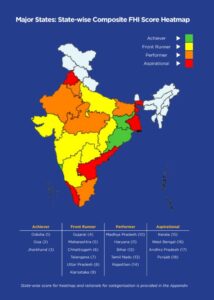
- Odisha remains the top performer, improving its score over the previous year, with Goa and Jharkhand also featuring among the top Achiever states. Gujarat and Maharashtra continue in the top five, while Haryana records a notable year-on-year improvement of three ranks. Bihar, Karnataka and Telangana show a mild recovery, whereas Punjab, West Bengal and Kerala remain at the bottom of the rankings.
- Overall, higher-ranked states display stronger fiscal discipline and resource mobilisation efforts, while lower ranked states exhibit higher non-developmental expenditure and less sustainable fiscal patterns.
- The Achiever group (Odisha, Goa and Jharkhand) is characterised by high own-tax shares (above 60%), relatively large capital outlay (around 4–5% of GSDP), low fiscal deficits (below 3% of GSDP), moderate debt levels (under 25% of GSDP) and contained interest burdens.
- Front-Runner states (Gujarat, Maharashtra, Chhattisgarh, Telangana, Uttar Pradesh and Karnataka) and Performer states (Madhya Pradesh, Haryana, Bihar, Tamil Nadu and Rajasthan) broadly maintain their positions with minor reshuffling, though their scores moderate slightly compared to the previous year.
- Aspirational states (West Bengal, Kerala, Andhra Pradesh and Punjab) face persistent revenue and fiscal deficits often breaching FRBM norms, elevated debt levels of roughly 35–45% of GSDP, committed expenditure accounting for about 50–60% of revenue receipts, large interest payments exceeding 15–20%, and relatively low developmental spending.
- Most states strengthened on Quality of Expenditure, with Jharkhand and Uttar Pradesh moving from Front Runner to Achiever, and Gujarat, Rajasthan, Andhra Pradesh improving from Performer to Front Runner. Majority of states, retained their earlier category.
- Goa and Odisha continue to record high State Own Revenue ratios, reflecting strong tax bases and greater fiscal autonomy. Jharkhand slipped from Front Runner to Performer, while most other states witnessed only marginal reshuffling within the same category.
- Bihar improved from Aspirational to Performer, signalling better deficit management. In contrast, Karnataka and Telangana moved from Front Runner to Performer, and Kerala and Tamil Nadu slipped further to the Aspirational group, highlighting emerging fiscal pressures.
- Odisha, Gujarat and Maharashtra maintain low debt levels and contain interest burdens, supporting fiscal sustainability. Conversely, Punjab, Kerala and West Bengal continue to face elevated debt and interest commitments, and several mid-tier states show rising leverage, though many remain within their existing category bands
Highlights: NE/Himalayan States:
- The North Eastern (NE) /Himalayan States have been ranked separately from the major states and classified into three groups i.e., Achievers (Arunachal Pradesh, Uttarakhand), Performers (Assam, Meghalaya, Mizoram, Sikkim, Tripura) and Aspirational (Himachal Pradesh, Manipur, Nagaland).
- Arunachal Pradesh ranks highest, followed by Uttarakhand and Tripura, reflecting stronger expenditure quality, revenue capacity and debt management, whereas Himachal Pradesh and Manipur remain at the bottom due to weak revenues and persistent fiscal stress.
- Meghalaya and Assam occupy upper middle positions with mixed indicator performance, while Mizoram, Nagaland and Sikkim display uneven performance across different fiscal metrics. Mizoram has low score under debt sustainability, Sikkim scores low on Fiscal Prudence and Nagaland has lower scores on Quality of Expenditure and Revenue Mobilisation.
- Arunachal Pradesh and Meghalaya improved through higher capital outlay and developmental spending exceeding two-thirds of total expenditure, whereas Tripura, Himachal Pradesh and Manipur face crowding-out from large salary and pension commitments.
- Uttarakhand and Himachal Pradesh exhibit relatively stronger own-revenue capacity, while Tripura, Nagaland and Manipur have weaker revenue mobilisation and central transfers form over 80% of revenue.
- Arunachal Pradesh maintains lower deficits and occasional surpluses through controlled revenue spending, but several states continue to run deficits around 4–5% of GSDP due to rigid expenditure structures.
- Assam, Tripura and Uttarakhand maintain moderate debt burdens, whereas Manipur and Himachal Pradesh carry high debt levels of roughly 40–50% of GSDP with rising servicing pressures.
The full publication can be accessed at: https://niti.gov.in/sites/default/files/2026-03/Fiscal-Health-Index-2026.pdf