
Context: The Government of India has approved Nutrient-Based Subsidy (NBS) rates for Rabi 2025–26 to ensure affordability of fertilizers, promote balanced nutrient application, and sustain farm productivity.
Balanced fertilization is crucial for maintaining soil health, enhancing crop productivity and ensuring long-term agricultural sustainability. In recognition of this, the Government of India continues to prioritize the Nutrient-Based Subsidy (NBS) Scheme, a critical policy intervention that promotes the judicious use of fertilizers by supporting farmers in accessing key nutrients at affordable prices.
Nutrient-Based Subsidy (NBS) scheme
- The Government of India introduced the Nutrient-Based Subsidy (NBS) scheme, effective from April 1, 2010.
- The scheme represented a significant policy shift in the fertilizer sector, designed to make fertilizers available to farmers at subsidized, affordable, and fair prices, while simultaneously encouraging their balanced and efficient use.
- Under the NBS framework, subsidies are determined based on the nutrient content of fertilizers, primarily NPKS: Nitrogen (N), Phosphorus (P), Potassium (K), and Sulphur (S).
- This approach not only encourages balanced nutrient application but also empowers farmers to make informed choices that align with the specific needs of their soil and crops.
- By promoting the use of secondary and micronutrients, the scheme also addresses issues of soil degradation and nutrient imbalance that have emerged from years of skewed fertilizer usage.
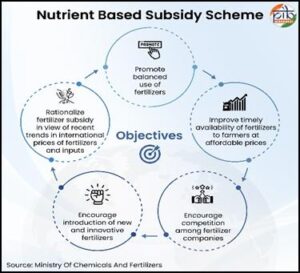
Outcomes and Policy Priorities of Nutrient-Based Subsidy Scheme
- The Nutrient-Based Subsidy (NBS) Scheme of the Ministry of Chemicals and Fertilizers aims to promote the balanced use of essential nutrients, such as nitrogen, phosphorus, potassium, and sulphur, thereby helping farmers avoid over-dependence on any single fertilizer and maintain soil health while improving productivity.
- It ensures that fertilizers are available to farmers on time and at affordable, subsidized prices, which is vital for smooth crop planning.
- The scheme also fosters healthy competition among fertilizer companies, driving improvements in quality, innovations, and efficiency in the fertilizer market.
- By supporting the introduction of new and innovative fertilizers, including advanced and micronutrient-enriched products, the NBS scheme helps modernize agricultural practices.
- Additionally, it focuses on rationalizing subsidies by aligning them with global price trends of fertilizers and raw materials, ensuring both farmer support and fiscal responsibility.
Major Provisions and Salient features of NBS Scheme
- Under the Nutrient-Based Subsidy (NBS) Scheme, the government provides a fixed subsidy, revised annually or biannually, on Phosphatic and Potassic (P&K) fertilizers, including DAP. The subsidy amount is linked to the nutrient composition of each fertilizer grade.
- Until Rabi 2023–24, the NBS scheme included 25 P&K fertilizer grades such as DAP, MOP, and SSP. From Kharif 2024 onward, three additional fertilizer grades have been incorporated into the scheme.
-
- NPK (11:30:14) fortified with Magnesium, Zinc, Boron, and Sulphur
- Urea-SSP (5:15:0:10)
- SSP (0:16:0:11) fortified with Magnesium, Zinc, and Boron
- With the addition of the new grades, the Government is now providing farmers with 28 types of P&K fertilizers at subsidized rates through authorized manufacturers and importers. In line with its farmer-centric approach, the Government continues to prioritize the affordable availability of these fertilizers at competitive prices.
- Under the NBS Scheme, the P&K fertilizer sector operates under a decontrolled regime, allowing companies to set the Maximum Retail Price (MRP) at reasonable levels, subject to government oversight. As a result, farmers receive the benefit of the subsidy directly when they purchase these fertilizers.
- Any P&K fertilizer covered under the NBS Scheme that is fortified or coated with Boron or Zinc (as specified in the Fertilizer Control Order) will continue to receive subsidy. In addition, these fortified or coated fertilizers will receive an extra subsidy per metric tonne (MT) to promote their use in conjunction with the main nutrients.
Operational Management and Compliance Monitoring of the NBS (Rabi 2025–26)
- To ensure transparency, accountability, and fair pricing under the Nutrient-Based Subsidy (NBS) Scheme for Rabi 2025–26, the Government of India has instituted a robust regulatory and digital oversight framework, implemented primarily through the Department of Fertilizers in coordination with the Department of Agriculture & Farmers Welfare.
- Fertilizer companies must submit audited cost data as per guidelines to enable assessment of the reasonableness of MRPs for all P&K fertilizer grades. Firms are required to regularly report MRPs, ensure alignment with notified subsidy rates, and sell fertilizers strictly at reasonable MRPs.
- Profit beyond prescribed thresholds is deemed unreasonable and recoverable. Reasonable margins are capped at 8% for importers, 10% for manufacturers, and 12% for integrated manufacturers over the cost of production of the final P&K product.
- Each fertilizer bag must clearly display the Maximum Retail Price (MRP) and the applicable subsidy per bag and per kilogram. Overcharging above the printed MRP constitutes an offence punishable under the Essential Commodities Act, 1955.
Integrated Fertilizer Management System:
-
- It is a digital platform that provides a range of online services related to fertilizer distribution and management.
- It includes dealer registration, stock availability tracking, dealer search, and access to the Management Information System and Direct Benefit Transfer (DBT) reports.
- By enabling transparency, improving efficiency, and supporting real-time tracking throughout the fertilizer supply chain, iFMS helps ensure that farmers and stakeholders receive timely access to high-quality fertilizers.
- Delivery and Transportation Responsibility: All manufacturers, marketers, and importers—including Single Super Phosphate (SSP) manufacturers—must deliver fertilizers up to the retail point on an F.O.R. (Freight on Road) basis, ensuring last-mile availability.
- iFMS services include dealer registration, stock tracking, dealer search, MIS dashboards, and DBT reports, enabling real-time transparency.
Major Milestones and Achievements
- Domestic Production Growth: Policy support under NBS has increased DAP and NPKS output by over 50%, from 112.19 LMT (2014) to 168.55 LMT (2025), strengthening indigenous capacity and advancing Atmanirbharta.
- Soil Health and Productivity Gains: Balanced application of P&K fertilizers has addressed multi-nutrient deficiencies and improved yields, with foodgrain productivity rising from 1,930 kg/ha (2010–11) to 2,578 kg/ha (2024–25).
- Sustained Fiscal Support: Between 2022–23 and 2024–25, over ₹2.04 lakh crore was allocated under NBS for indigenous and imported P&K fertilizers, ensuring affordability and availability for farmers.
Conclusion
The NBS Scheme stands as a cornerstone of India’s fertilizer policy, combining calibrated subsidies, strict compliance norms, and comprehensive digital monitoring. Expansion of subsidised grades, incentives for indigenous and fortified fertilizers, and iFMS-led transparency have collectively ensured balanced fertilization, improved soil health, higher productivity, and fiscal discipline—aligning farmer welfare with sustainability and self-reliance.